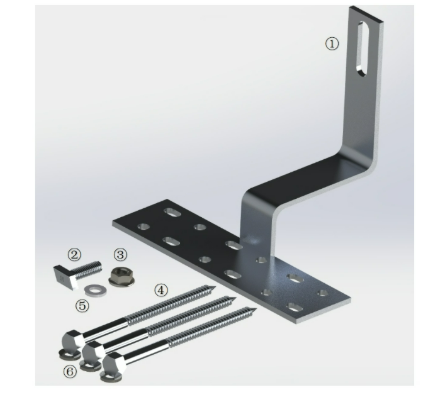
S-Tile Roof Hook - Stainless
Pickup available at USA Fulfillment Center
Usually ready in 24 hours
Talk to Real Experts Anytime
Talk to Real Experts Anytime
Lifetime tech support from our in-house specialists
Hassle Free Warranty
Hassle Free Warranty
Effortless Warranty for Your Ease.
Unbeatable Value, Guaranteed
Unbeatable Value, Guaranteed
Find it cheaper elsewhere? We'll match it.
Speak To a Solar Specialist
S-Tile Roof Hook - Stainless

solar industry experience
10,000+ American
customers
return policy
Warranty
What it is, and what it is for
S-Tile Roof Hook, stainless steel
A stainless steel roof hook for mounting solar rails on S-profile (Spanish or mission) clay and concrete tile roofs. The hook lags into the rafter under the tile, its arm follows the curve of the tile and comes out at the overlap, and the tile goes back in place over it, so the roof stays weather-tight without cutting or flashing a tile. The rail clamps to the slotted top of the hook.
Sold per hook. Plan on one hook per rail support point, typically every 4 ft along each rail, so a two-rail row of four panels needs eight to ten hooks; the exact spacing comes from the rail maker's span tables for your wind and snow loads. Use stainless lag bolts sized to the hook's slots and seal the lag penetration. For shingle roofs use a flashed mount instead.
Layout and fixing spacing are for reference; a licensed installer or engineer should confirm the attachment for your roof.
Every number, by component.
The figures the manufacturer publishes. The datasheet above is the reference if the two ever differ.
| Roof type | S-profile (Spanish / mission) clay and concrete tile |
|---|---|
| Material | Stainless steel |
| Attachment | Lag bolts into the rafter, under the tile |
| Rail interface | Slotted top plate for standard solar rail hardware |
| Sold as | One hook (lag bolts and rail hardware not included) |
Before you order.
If yours isn't here, ask an engineer. It costs nothing and it's the step most people skip.
What if I'm not sure this is the right product?
Ask before you order. Send us what you need to run, or your pool or well figures, and an engineer will confirm the choice — it costs nothing. Or use the finder below, which sizes from what you actually run and shows its reasoning.
Read it all? Add it to your cart.
Same price and options as at the top of the page. Shipping is worked out at checkout from your address.