Catalogue · 4 products

Hybrid Solar System

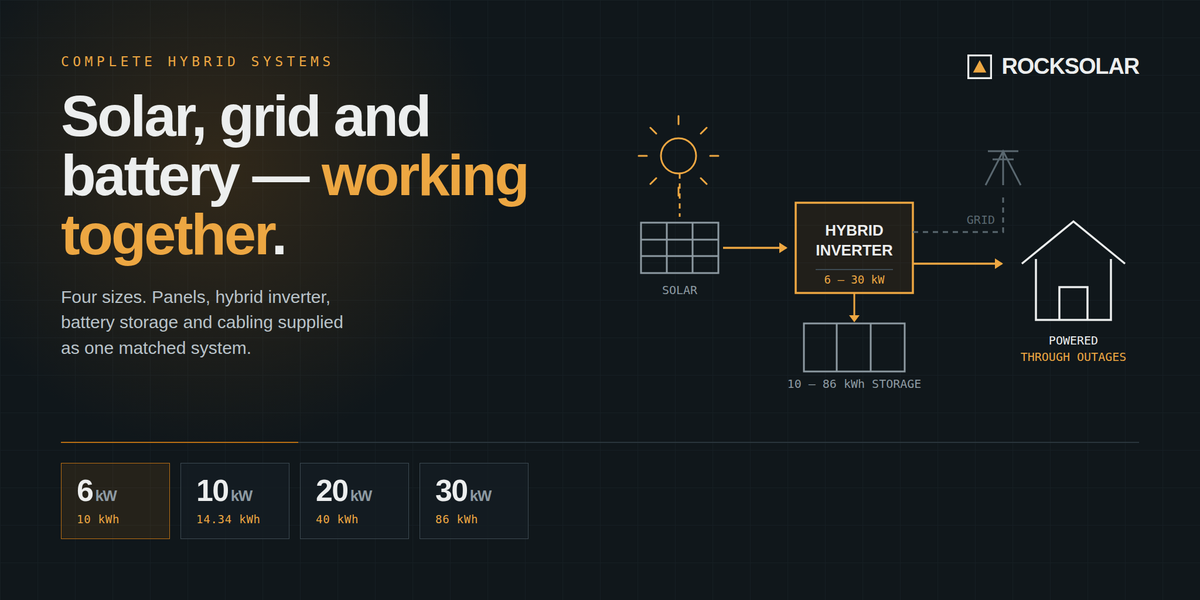
A hybrid solar system runs on three sources at once — sunshine, your battery, and the grid — and switches between them automatically. It is the only kind of solar system that keeps your building powered when the utility goes down.

Every system below is supplied as one matched package: bifacial solar panels, a hybrid inverter, battery storage, cabling and protection devices, sized to work together. Four sizes, from a family home to a commercial building.

Not sure which one? Tell the finder what you need to run and it sizes a system from stock, with the reasoning shown.

Rather ask? Talk to an engineer.

Hybrid Solar System

Hybrid Solar System

ROCKSOLAR

A hybrid solar system runs on three sources at once — sunshine, your battery, and the grid — and switches between them automatically. It is the only kind of solar system that keeps your building powered when the utility goes down.

Every system below is supplied as one matched package: bifacial solar panels, a hybrid inverter, battery storage, cabling and protection devices, sized to work together. Four sizes, from a family home to a commercial building.

What is a hybrid solar system?

A standard grid-tie system feeds solar power into your building and sells the surplus back to the utility — but when the grid fails, it shuts down too, for the safety of line workers. An off-grid system has batteries and no utility connection at all.

A hybrid system sits between the two. It stays connected to the grid, but it also stores energy in a battery. That means you cut your electricity bill on ordinary days and keep the lights, the fridge and the well pump running during an outage — with no generator, no fuel, and no start-up delay.

How a hybrid solar system works

  • Through the day — the panels power your building directly and charge the battery with whatever is left over.
  • In the evening — the battery takes over, so you use the power you generated instead of buying it back at peak rates.
  • During an outage — the inverter disconnects from the grid and runs your building from solar and battery alone. Transfer is automatic and fast enough that most equipment never notices.
  • On a dull week — the grid quietly fills any gap, so you are never left short.

Compare our hybrid solar systems

The inverter size sets what you can run at once. Add up the heaviest things that must work simultaneously — an air conditioner, a well pump, a workshop compressor — and size the inverter above that, with headroom for motor start-up surge.

The battery size sets how long you run without sun. A larger battery does not power more equipment; it powers the same equipment for longer. If outages in your area last hours, the smaller battery is enough. If they last days, or if your utility charges more at peak times, the larger option earns its money back.

Not sure? Send us a list of what has to keep running, or a recent power bill, and we will confirm the size before you order. That costs nothing and it is the step most people skip.

System Inverter Solar array Battery storage Suited to
6 kW Hybrid 6 kW 7.04 kW 10 kWh A family home or cottage with everyday loads
10 kW Hybrid 10 kW 11.88 kW bifacial 14.34 kWh or 20 kWh A full house, including heat pump or air conditioning
20 kW Hybrid 20 kW 24.57 kW 40 kWh or 57.36 kWh A farm, workshop or large property with motor loads
30 kW Hybrid 30 kW 36.86 kW 60 kWh or 86.04 kWh Commercial buildings and ground-mount installations
View as

Common Questions

What is a hybrid solar system?

A hybrid solar system combines solar panels, a hybrid inverter, battery storage, and a connection to the utility grid. During the day, solar energy can power your home and charge the batteries. Stored energy can then be used at night, during peak-rate periods, or as backup power during a utility outage.

Is a hybrid solar system good for home backup power?

Yes. Hybrid solar systems are a popular option for homeowners who want both solar energy savings and battery backup. When properly designed, the battery and hybrid inverter can supply designated household loads during a utility outage.

Can a hybrid inverter work without a battery?

Most can run as an ordinary grid-tie inverter with no battery fitted, and have storage added later. You lose outage protection until the battery is installed — that is the whole reason to buy hybrid rather than grid-tie.

How much does a hybrid solar system cost?

Complete systems on this page range from roughly $9,700 to $39,600, depending on inverter size and how much storage you choose. That covers the equipment; installation, permits and racking are additional and vary by site.

Can I use grid electricity when my solar battery is low?

Yes. One advantage of a hybrid solar system is its ability to work with multiple energy sources. Depending on system settings and configuration, your home can use solar energy, stored battery energy, and utility power.

Can I install a hybrid solar system on the roof or ground?

Yes. Hybrid solar systems can use either roof-mounted or ground-mounted solar arrays.

The best option depends on available space, shading, roof condition, orientation, local codes, and the amount of solar capacity required.

Does a hybrid solar system require professional installation?

Professional installation is recommended. Hybrid systems involve high-voltage solar DC, batteries, utility interconnection, grounding, transfer equipment, and 120/240V AC electrical systems.

Will it work with my existing solar panels?

Often, if the array voltage and current fit within the hybrid inverter's limits. Send us your panel model and how they are wired, and we will check it before you order.

What sizes of ROCKSOLAR hybrid solar systems are available?

ROCKSOLAR offers multiple hybrid solar configurations for U.S. homes and larger properties. Current options include systems built around 6kW, 10kW, 20kW, and 30kW inverter capacities, with solar and battery storage configurations designed for different energy and backup requirements.

Compare /3

Loading...